Azim Hossain Tuhin
Web Developer
How to Dynamically Annotate Popular Restaurants Using Django ORM
Django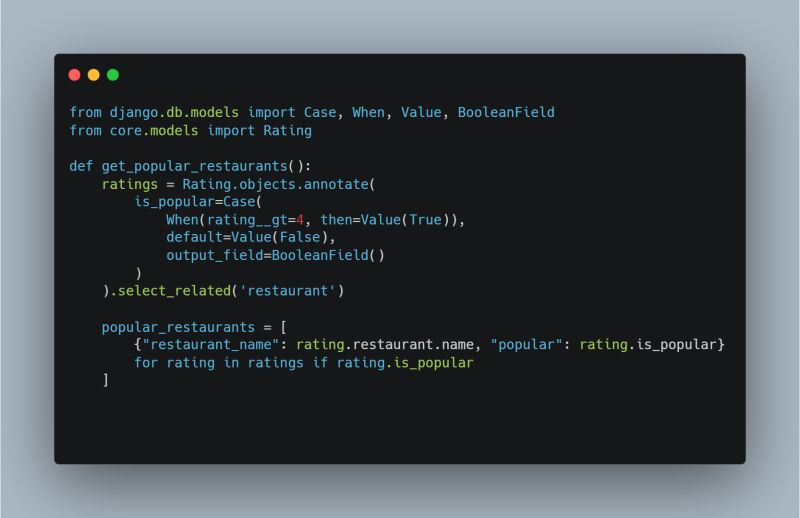
- 422 views
- April 25, 2025
In modern web applications, especially those involving reviews or ratings, it's important to identify and highlight popular content based on user engagement. Whether it's a restaurant, product, or article, marking certain items as "popular" improves user experience and encourages discovery.
This blog explores how to achieve this efficiently using Django ORM's annotation system—without writing raw SQL or adding extra logic in your Python code.
What We Want to Achieve
Our goal is to dynamically tag restaurants as "popular" if their rating meets a certain condition—such as having a rating of 4 or higher. Instead of modifying the database structure or writing custom Python loops, we'll use Django's powerful built-in tools to handle this at the query level.
Why Use Django Annotations?
Django's ORM provides the annotate() method, allowing developers to add calculated fields to querysets. With annotations, you can:
-
Add virtual fields like
is_popularbased on logic -
Perform conditional checks directly at the database layer
-
Filter or format results more cleanly in templates or APIs
This approach improves performance, reduces unnecessary data processing, and keeps the business logic centralized and maintainable.
Benefits of This Approach
-
Performance Optimized: Logic is processed at the database level, reducing server-side load.
-
No Raw SQL Required: Use Django’s expressive syntax for conditional logic.
-
Easier Maintenance: Centralized logic that can be reused across views, templates, and APIs.
-
Clean Integration: Ideal for dashboards, admin panels, API responses, or frontend lists.
Real-World Applications
-
Highlighting top-rated restaurants in a food delivery platform
-
Tagging best-selling products in an eCommerce site
-
Featuring trending posts in a blog or news platform
-
Marking verified or recommended users in a social app
Conclusion
Using Django annotations to mark popular items like restaurants based on dynamic conditions is a clean, scalable, and efficient solution. It’s a best practice for Django developers looking to implement business logic at the ORM level without compromising performance or maintainability.
Whether you’re building a food app, a product catalog, or a review-based platform, mastering conditional annotations in Django will help you write smarter and faster queries.